
Doc Week prepares Educational Leadership students to lead across professions
For many professionals, earning a doctoral degree is an opportunity to expand where and how they can make a difference.
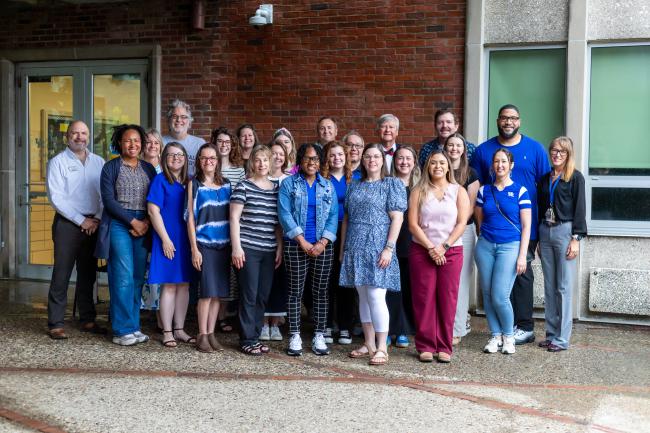
For online doctoral students in the UK College of Education Department of Educational Leadership Studies, that journey includes a visit to the UK campus each summer. Known as “Doc Week,” it’s a chance to learn alongside the faculty and classmates they’ve come to know virtually.
Doc Week participant Paige Maynard is pursuing a Doctor of Philosophy (Ph.D.) to influence positive change for young children who are blind and have low vision.
“It has been so eye-opening to see how each member of my cohort comes from a different background and works in a different field, but we all share the thread of wanting to learn to lead well and make things better in our spaces,” said Maynard, who works as the Kentucky Education Lead at VIPS, a nonprofit agency that provides early intervention and educational services to young children in Kentucky and Indiana who have blindness or low vision.
Casey Humphrey is an occupational therapist by trade and works in higher education in an occupational therapy doctorate program. She’s interested in best practices for teaching students enrolled in occupational therapy professional programs. Earning a Ph.D. in Educational Leadership is also a chance to advance her career while strengthening her research expertise.
“The leadership theory that I have been exposed to in this program has helped me to view situations in my leadership role from various perspectives,” Humphrey said. “This has been helpful in effective decision making and promoting positive organizational change."
Beth Rous, chair of the Department of Educational Leadership Studies and professor in the UK College of Education, said Doc Week reflects the breadth of leadership represented within the department’s doctoral programs.
"Doc Week reminds us that doctoral education is both an intellectual and a relational experience,” Rous said. “Students arrive with different professional expertise, research interests and ways of understanding leadership. When they work together in person, those differences become an important resource. They learn not only from faculty, but also from one another, and they begin to see how their individual research can contribute to broader educational and community change."
The energy when students and faculty come together during Doc Week is unmistakable, said UK College of Education Dean Nick Pace, Ed.D.
“At the end of the day, this is a relationship business, and Doc Week solidifies those long-term bonds,” Pace said. “I'm so proud of the culture our faculty and staff have built to make this happen."
While the online format makes the doctoral program accessible for working professionals, both students said the time spent during Doc Week deepened the experience in ways that are difficult to replicate virtually.
“Having the ability to spend face-to-face time with the faculty and my cohort in an academic and casual environment helps to cement the relationships that are so helpful as we move through the program,” Humphrey said. “I love having the opportunity to pull my committee chair aside and ask quick clarifying questions that may have had to wait for a formalized meeting when in a virtual environment and getting to know about each other's lives outside of academics. And it's just a lot of fun being on campus."
For Maynard, the week offered an opportunity to better know her classmates while preparing for the next phase of her doctoral journey.
“Doc Week gave me the opportunity to build relationships with my peers and the program faculty. I got to know them on a more personal level in many ways. I loved the opportunity to learn more about their research interests and why they are passionate about them. From a program perspective, it was very helpful that we spent time at Doc Week learning about the dissertation process, including what to expect and how to plan.”